Beginner sequence · Step 1 of 3
Start here
Readiness check: Students can follow forward and turn commands. If not, begin with the Grade 3 Robot Route warm-up before introducing repeat.
Exact starter recipe
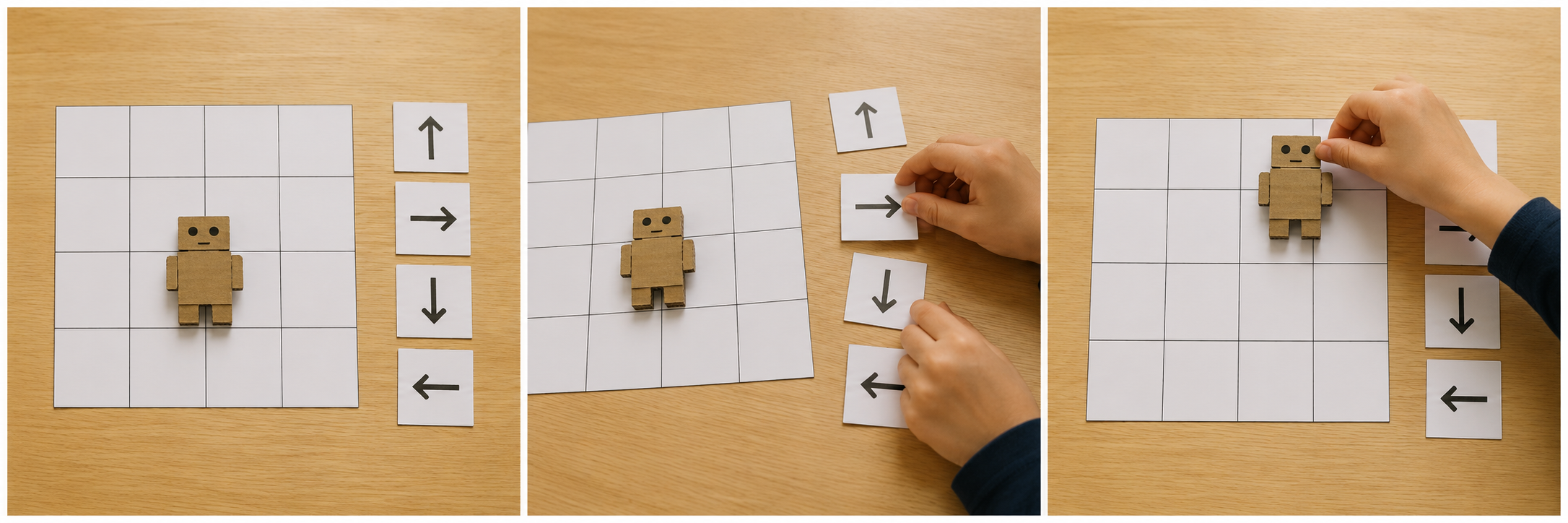
Start bottom-left facing up; goal is top-right on a 4 × 4 grid.
Long version: FORWARD, FORWARD, FORWARD, TURN RIGHT, FORWARD, FORWARD, FORWARD
Loop version: REPEAT 3 [FORWARD], TURN RIGHT, REPEAT 3 [FORWARD]
The repeat card runs its enclosed command exactly three times. Turns still stay in place.
Make the simplest version work first. Then use the test and extension in this lesson.
For teachers
Engineering standards
This shows how the lesson connects to the national NGSS engineering standards and what student work you can collect.
3-5-ETS1-1
Define the user's need for robot route: repeat the steps and agree on the listed success criteria and limits.
What students show: A stated user need and checked criteria; this is engineering-design practice, not a separate coding standard.3-5-ETS1-2
Compare two possible routes, pet behaviors, or switch arrangements before selecting one for the user.
What students show: Two small plans and a reason for the selected design.3-5-ETS1-3
Repeat the stated test under the same conditions, identify a failure, change one feature, and retest.
What students show: Before-and-after test entries and an explanation connecting the change to the result.Materials
- Paper 4 × 4 square grid, start marker and goal marker
- Large cardboard robot token with a clear front arrow
- Paper command cards: forward one square, turn left, turn right; repeat cards for Grade 5
- Pencils, timer optional, and printable design brief
Teacher preparation
- Check readiness: Students can follow forward and turn commands. If not, begin with the Grade 3 Robot Route warm-up before introducing repeat.
- Prepare repeat brackets and count cards; show which cards are inside the loop.
- Choose a route with repeated actions and mark its fixed starting direction.
- Prepare the printable design brief at the end of this page. Use the project picture as inspiration, not a technical diagram or a required artistic finish.
Step by step
How to teach it
Meet the beginner challenge
- Create a compact paper program for a robot delivery route. Compare a full command list with a repeat-based version that reaches the same goal.
- Read the criteria together. Ask students to predict what the system should do.
Model one working action
- Write a complete route from the start to the delivery square using forward and turn cards.
- Trace the route and mark any command that repeats without interruption.
- Use the exact starter recipe below. Ask a student to explain the action before demonstrating a second step.
Compare two small plans
- Sketch or arrange two possible solutions using the same materials.
- Compare each plan against the criteria; choose one and state a reason.
Build the smallest working version
- Replace a repeated group with a repeat card and count. Keep turn cards outside unless a turn is meant to repeat.
- Have one partner expand the repeat into individual moves while the other checks the token.
- Compare both versions from the identical start. Record the actual moves as well as the number of written cards.
Check and save
- Show one working action. Record where you stopped and what you need next.
- Keep the command cards in order in a labeled envelope.
- Return materials and reset the workspace.
Rebuild understanding
- Read the saved plan and predict the first test.
- Reset the starting state and test the simplest action.
Test fairly
- Run the long version once and record the ending square and direction.
- Run the repeat version three times from the same starting state. Record whether its finish matches.
- Distinguish fewer written instructions from fewer robot moves; the loop does not automatically shorten the physical path.
Improve one thing
- Identify the first point where the result differed from the prediction.
- Change one instruction, code block, or mechanical feature. Repeat exactly the same test.
- If the core skill is secure, offer the extension; otherwise use the support option.
Share evidence and clean
- Let another pair try the project with your directions.
- Use the worksheet to show an original result, a change, and the new result.
- Save or label the work, then return materials.
Assessment
- Long and loop versions reach the same finish from the same start.
- Repeat count and loop boundaries are clear.
- Student explains why a shorter program can still make the same number of moves.
- Student predicts an outcome before testing.
- Test record distinguishes expected and actual results.
- Student explains why the revision helps; neat decoration and speed are not assessment criteria.
Supports & extensions
- Use a single repeat-three-forward loop first; leave turns outside the loop.
- Offer larger cards or tools, a stabilized work surface, picture cues, partner assistance, and spoken or dictated evidence.
- Extension after success: Create a new blocked-square route and explain when a loop helps and when an ordinary sequence is clearer.
Safety & responsible use
- Use a tabletop grid and large paper cards. Do not blindfold students or use a walking robot activity near furniture.
- Use school scissors with adult-prepared cardboard tokens; keep small pieces away from younger visitors.
No-machine alternative
Use drawn brackets around arrows on paper and a finger-sized marker; no computer is needed.
Printable student design brief
The challenge
Create a compact paper program for a robot delivery route. Compare a full command list with a repeat-based version that reaches the same goal.
Success criteria
- Long and loop versions reach the same finish from the same start.
- Repeat count and loop boundaries are clear.
- Student explains why a shorter program can still make the same number of moves.
Constraints
- Tabletop only; one command moves or turns the token, not both.
- Use two 45-minute meetings; start with the working system before decoration.
- Keep test conditions consistent and change only one feature at a time.
Engineer’s notes
Printable beginner test record
Predict. Try. Improve.
Name ____________________ Partner ____________________
Our success rule: __________________________________________________
| Trial | Input / action | Expected result | First result | Result after one change |
|---|---|---|---|---|
| 1 | ||||
| 2 | ||||
| 3 | ||||
| 4 | ||||
| 5 | ||||
| 6 | ||||
| 7 | ||||
| 8 | ||||
| 9 | ||||
| 10 |
Use three rows for the introductory tests or all ten for switch reliability. Write the held, released, or other-key state for each sensing test.
One thing we changed: ______________________________________________
Things we kept the same: ____________________________________________
Our evidence shows: _________________________________________________