For teachers
Engineering standards
This shows how the lesson connects to the national NGSS engineering standards and what student work you can collect.
3-5-ETS1-1
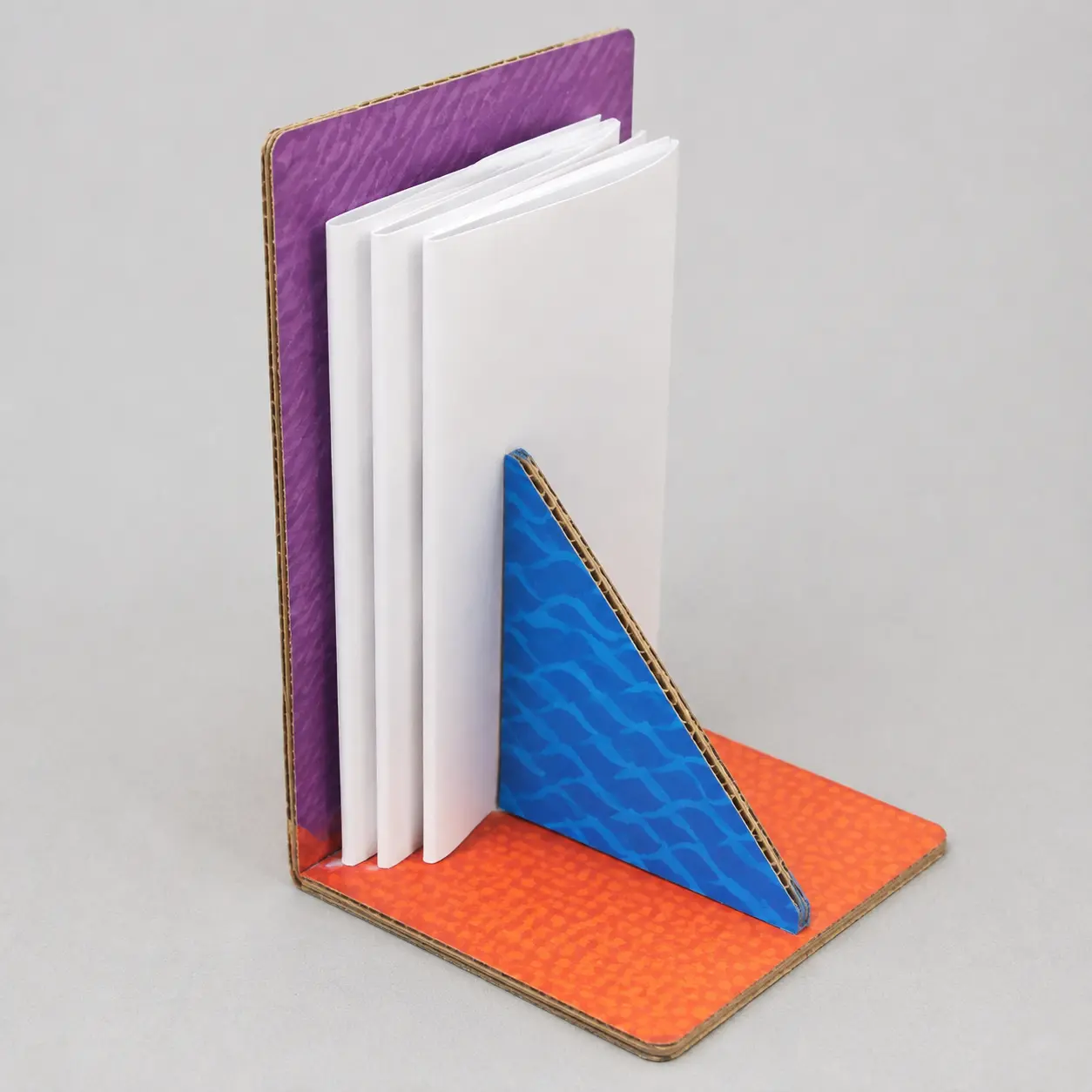
Define the need in Make a cardboard bookend that keeps three lightweight classroom booklets upright on a table. Agree on the two success checks and the listed material limits.
What students show: Two labeled ideas with the target and limits stated.3-5-ETS1-2
Compare the ideas using the project checks: Keeps three light booklets upright; Does not slide during the 30-second check.
What students show: A selected design with a reason connected to a success check.3-5-ETS1-3
Test, change one feature and retest: Set the same three booklets upright for 30 seconds in three trials. Record sliding or bending. Change one brace size or base length, then repeat on the same table with the same booklets.
What students show: Before-and-after results collected under the same conditions.Materials
- Cardboard
- tape
- ruler
- three thin booklets
- nonslip scrap paper
- Pencil, planning paper and the printable design brief below
Teacher preparation
- Gather per-pair materials: Cardboard; tape; ruler; three thin booklets; nonslip scrap paper.
- Make one rough sample and rehearse the exact test: Set the same three booklets upright for 30 seconds in three trials. Record sliding or bending.
- Set the size, load or distance marks mentioned in the steps before class. Demonstrate an ordinary first attempt, not a perfect model to copy.
- Prepare any holes, fasteners or difficult cuts for students. Check the stated safety note and clear the testing space.
Step by step
How to teach it
See the job and plan
- Introduce the finished object: Make a cardboard bookend that keeps three lightweight classroom booklets upright on a table.
- Measure the booklets and sketch two L-shaped supports with different braces.
- Students say what would count as a successful result.
Model the unfamiliar action
- Demonstrate slowly: Fold a base and upright from cardboard. Mark the corner that tends to bend.
- Pause so partners can repeat the action; provide prepared parts if cutting or folding blocks progress.
Build the first version
- Add a triangular brace and place the base under the booklet ends. Use no heavy books.
- Partners swap builder and checker roles halfway through. Check the working part before decorating.
Try once and save
- Run one trial of the stated test to locate an obvious problem. Do not count a changed procedure as a fair comparison.
- Label and store the model; sketch its current shape and clear the work area.
Predict and set up
- Revisit the two success checks. Agree on identical starting conditions and prepare a before/after results table.
Collect evidence
- Set the same three booklets upright for 30 seconds in three trials. Record sliding or bending.
- One student operates while the other records. Swap for a later trial while noting a change of operator if it affects the result.
Change one thing
- Change one brace size or base length, then repeat on the same table with the same booklets.
- Keep the original results rather than replacing them with only the best attempt.
Explain and clean up
- Submit the bookend, side-view dimensions and stability results.
- Collect the brief and results; separate reusable materials and clean the test area.
Assessment
- Keeps three light booklets upright
- Does not slide during the 30-second check
- Student demonstrates the actual task: Set the same three booklets upright for 30 seconds in three trials. Record sliding or bending.
- Record includes failures as well as successes.
- Student identifies one changed feature and uses the retest to explain the result.
Supports & extensions
- Provide a worked first joint or sample; have students record dimensions and explain one comparison limitation.
- Start with the smallest working version of light-book bookend before decoration.
- Extension after success: choose one more value for the same tested feature, predict its effect and repeat set the same three booklets upright for 30 seconds in three trials.
Safety & responsible use
- Teacher checks materials and test conditions before use. Use classroom scissors; adults prepare difficult cuts, holes and fasteners.
- No powered tools, coding, hot glue or electrical circuits are required. Keep moving objects contained and test loads light.
- Keep pieces on the tabletop, do not mouth materials and stop if a part tears into a sharp or loose hazard.
No-machine alternative
Use prepared paper parts, larger pieces or an adult-assisted version of the same build. Keep the functional task: Make a cardboard bookend that keeps three lightweight classroom booklets upright on a table. If physical testing is not possible, label sketches as predictions rather than measured results.
Printable student design brief
The challenge
Make a cardboard bookend that keeps three lightweight classroom booklets upright on a table.
Success criteria
- Keeps three light booklets upright
- Does not slide during the 30-second check
- Record the stated test and explain one revision
Constraints
- Use only the listed teacher-approved materials
- Stay within the teacher-set size, load and test-space limits
- Two 45-minute meetings; keep the first version simple